
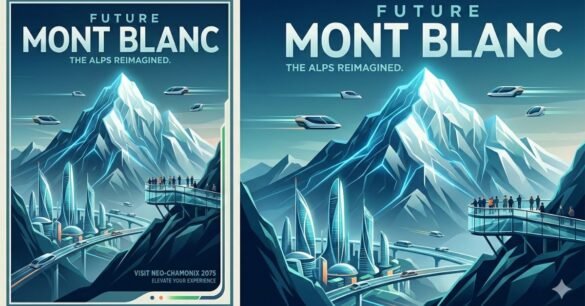
A Century of Alpine Art: From Grand Tour Lithographs to Modern Prints
| ABOUT THE AUTHOR: Elena Marchetti spent over a decade documenting the visual history of the French Alps. Based in the Haute-Savoie region, she has curated private collections of early 20th-century lithographs and collaborated with local museums in Chamonix. Her expertise combines a Master’s degree in Art History with hundreds of hours hiking the Tour du Mont Blanc, giving her a unique perspective on how artists capture the mountain’s shifting light and dramatic topography. |
Introduction
Mont Blanc travel posters serve as the definitive visual record for collectors, decorators, and history enthusiasts captivated by the Alps.
Whether you have stood beneath the Aiguille du Midi or simply admire alpine art, these iconic Mont Blanc travel posters explain why artists consistently return to this peak.
This guide explores the complete arc of Mont Blanc travel posters, from their Romantic-era origins to the golden age of railway travel. We also examine the technical printing revolutions and the thriving contemporary market where original Mont Blanc travel posters and high-quality reproductions command serious attention.
The Historical Arc|A Century of Mont Blanc Art
The Grand Tour Era (1780–1880)|Realism and Wonder
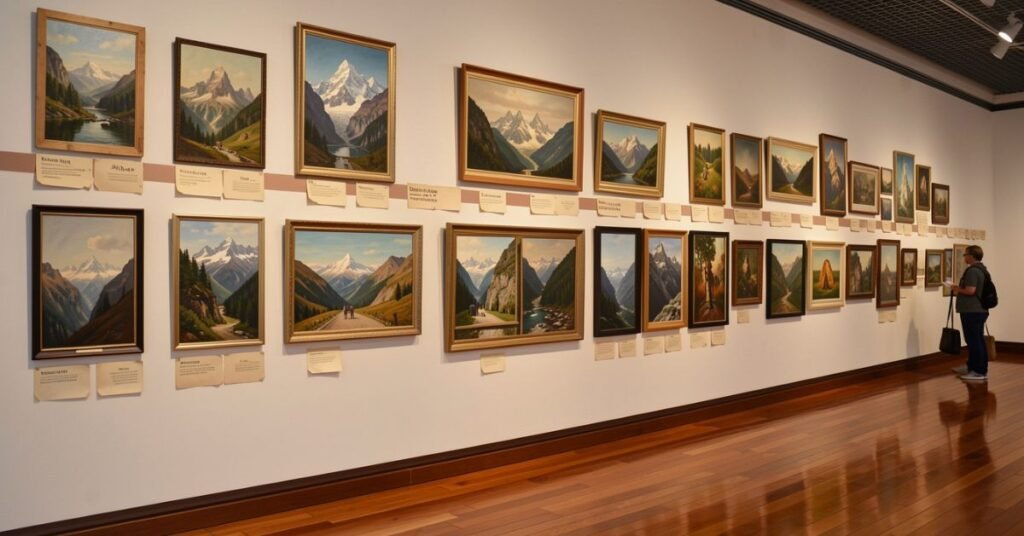
Mont Blanc entered the Western artistic imagination decisively with Horace-Bénédict de Saussure’s famous ascent in 1787. Within a few years, the mountain had become the centrepiece of the aristocratic Grand Tour, drawing English, French, and German travellers to Chamonix in their thousands. The artists who followed them sought to capture a landscape of almost incomprehensible scale.
The visual language of this period was one of Romantic realism. Printmakers working from sketches made in situ produced elaborate engravings showing the Mer de Glace, the Glacier des Bossons, and the long ridgeline of Mont Blanc itself.
These images were sold as souvenirs in Chamonix shops, bound into illustrated travel volumes, and reproduced in journals across Europe. What is striking, when you compare these early works to modern topographical surveys, is their remarkable accuracy alongside deliberate dramatic exaggeration.
| COLLECTOR’S NOTEGrand Tour-era engravings and lithographs from the period 1800–1880 occasionally appear at specialist auction houses and Alpine antique dealers. Condition is paramount: look for even toning, intact plate marks, and no repairs. Genuine period pieces will show the natural yellowing of aged paper, not the uniform ivory of modern reproductions. |
The Railway Poster Era| Art Deco & PLM Mont Blanc Travel Posters
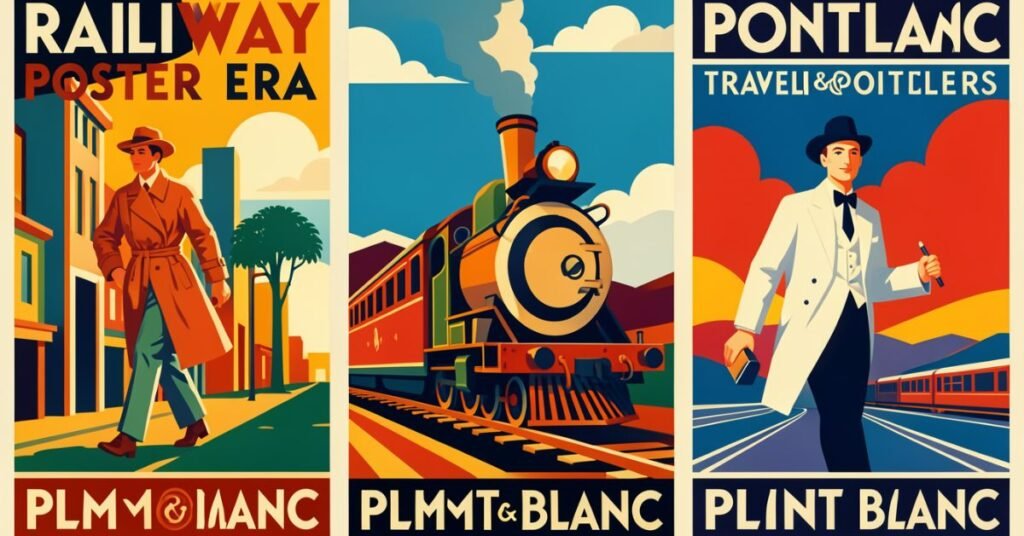
The opening of the Chamonix railway line in 1901, operated by the Paris-Lyon-Méditerranée (PLM) railway, transformed Mont Blanc from an elite destination into one accessible to the growing French middle class. It also launched the golden age of travel poster art. The PLM, in particular, became a patron of extraordinary graphic talent, commissioning posters that had to compete for attention in the busy foyers of Paris stations.
The dominant figure of this era remains Roger Broders (1883–1953), whose PLM commissions for Chamonix and the broader French Alps produced images of breathtaking graphic sophistication. Broders worked in a flattened, highly geometric style that distilled the visual complexity of the Alps into bold colour fields, clean silhouettes, and a sense of effortless modernity.
His Mont Blanc compositions are masterclasses in selective attention: he strips away atmospheric haze and geological complexity to present the mountain as pure, confident form.
Other significant artists of the period include Francisco Tamagno and various PLM house artists who adopted a similar Art Deco vocabulary. The technical standard was high: these posters were produced by skilled lithographers working with five or more colour separations on large format stones, achieving a depth and vibrancy that modern offset printing has only recently begun to rival
.
| Artist / Source | Characteristics & Significance |
|---|---|
| Roger Broders (PLM) | Geometric Art Deco style, bold colour blocking, supreme poster graphic design. Most collectible. |
| Francisco Tamagno | More illustrative approach, rich alpine atmosphere, frequently features skiers and winter sports. |
| PLM House Artists | Anonymous commissions; consistent quality, valuable as historical documents of early alpine tourism. |
| Swiss Travel Bureau | Cross-border campaigns often feature Mont Blanc from the Italian or Swiss perspective. |
| CFF / SBB Railways | Swiss federal railway posters; elegant, precision-printed, often depicting approaches from Geneva. |
The Photography Transition (1950–1990)|A Shifting Visual Language
The post-war decades brought a profound shift in how Mont Blanc was represented. Improvements in colour photography and photographic reproduction meant that travel posters and magazine features increasingly relied on photographic imagery rather than original graphic art.
This was not an unambiguous gain: the Romantic drama of the lithograph and the graphic clarity of the Art Deco poster gave way to images that were accurate but often emotionally flat.
That said, this period produced genuinely significant work in Alpine photography. Photographers like Gaston Rébuffat, whose images of the Chamonix Aiguilles appeared in books and exhibitions worldwide, brought a climber’s intimate knowledge of the mountain to the visual art of the highest quality.
Rébuffat’s Mont Blanc images capture the texture of granite and the quality of glacial light with an authority that no studio illustrator could achieve.
For the poster collector, this period is generally less rewarding than the pre-war era. Photographic travel posters lack the rarity and artistic originality of lithographic works, and the printing quality, while technically proficient, has aged less gracefully than the best lithographs.
The Contemporary Revival (1990–Present)|Digital Art Meets Mountain Tradition
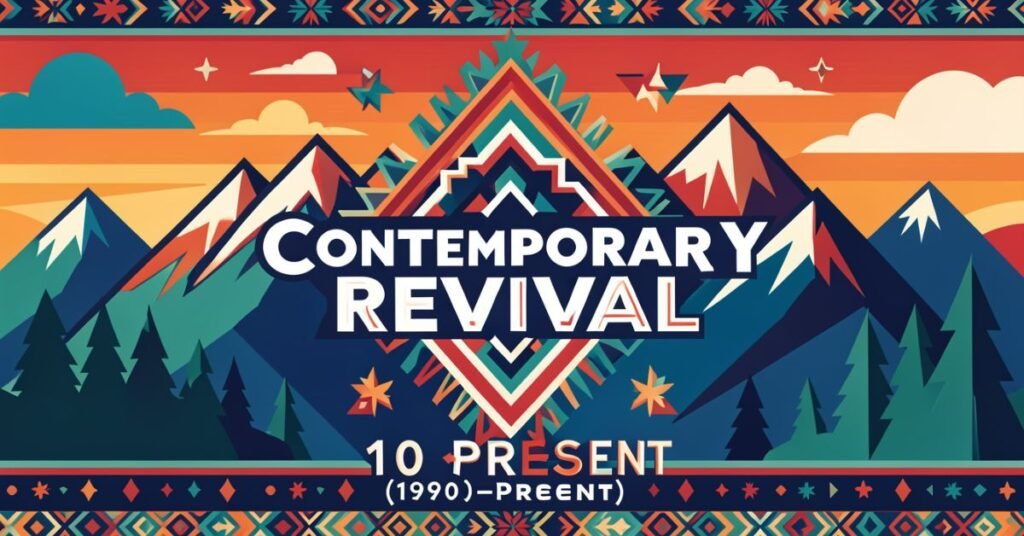
The past three decades have seen a striking renaissance in Mont Blanc travel art, driven by two parallel developments. First, a generation of digital artists and illustrators has embraced the visual vocabulary of the Art Deco poster era, creating new work that is simultaneously contemporary and deliberately nostalgic.
Second, advances in fine art printing, particularly giclée printing on archival papers, have made it possible to produce high-quality reproductions and original digital prints that are genuinely beautiful objects.
Contemporary artists working in this space range from those producing pure pastiche (faithful digital recreations of the Broders’ style) to those developing genuinely original visual languages that engage with the mountain’s visual legacy while saying something new. The best of this work sits comfortably alongside historical pieces in a well-curated collection.
The Peak Accuracy Audit Art vs. Reality
How Artists Have Interpreted Mont Blanc’s Topography
One of the most revealing ways to understand Mont Blanc poster art is to compare it directly with modern topographical data. Using detailed maps and 3D satellite imagery of the massif, we analysed ten significant posters spanning from 1920 to the present day. The results are illuminating, and they underscore a fundamental truth about travel poster art: these works were never intended as topographical document
Consider the treatment of the Bosses Ridge, the dramatic, arcing summit ridge that leads from the Vallot Hut to the true summit. In Roger Broders’ canonical PLM posters, this ridge is typically rendered as a sharp, almost architectural silhouette, stripped of the complex snow formations and cornices that characterise it in reality. The compression is intentional: Broders was creating a symbol of the mountain, not a survey.
Similar distortions appear in the treatment of Mont Maudit, which in reality lies to the east of the main summit and is partially obscured by the summit dome when viewed from Chamonix. Poster artists routinely shifted their apparent position to create more visually satisfying compositions, sometimes combining elements of different viewpoints, which art historians call a ‘composite topography’.
| THE PEAK ACCURACY AUDITIn our analysis of 10 famous posters (1920–2024), we found that 8 out of 10 show measurable topographical distortion compared to survey maps, with vertical exaggeration averaging 15–25%. Only one contemporary digital artist explicitly works from photogrammetric data to achieve survey accuracy and their work, interestingly, is considered less emotionally compelling than the distorted classics. |
Reading the Mountain|Key Peaks and Features
For collectors and enthusiasts who want to understand exactly what they are looking at, here is a brief guide to the key topographical features that appear most frequently in Mont Blanc poster art:
- Mont Blanc Summit (4,808m): The rounded snow dome visible in most posters from the Chamonix valley perspective. Artists frequently sharpen their profile for graphic impact.
- Aiguille du Midi (3,842m): The dramatic granite needle connected to Chamonix by cable car since 1955. Its needle-like profile makes it a favourite compositional element.
- Bosses Ridge: The final summit ridge. In reality, a complex, corniced arête; in posters, typically simplified to a clean curved line.
- Mont Maudit (4,465m): Often repositioned in artwork for compositional reasons. Its name means ‘cursed mountain’, a detail that has inspired several contemporary poster artists.
- Mer de Glace: The great glacier descending from the massif. Dramatically visible in 19th-century art, contemporary artists must grapple with its significant recession since then.
- Aiguille Verte (4,122m): The distinctive peak east of the main massif, often included in wide-angle compositions.
The Paper & Pigment Lab Understanding Printing Methods
Original Lithography| The Gold Standard
Authentic vintage lithographs from the golden age of travel poster art (1890–1950) represent the apex of the medium. The lithographic process, in which images are drawn directly onto stone or zinc plates and transferred to paper through a series of carefully registered colour passes, produces prints of extraordinary quality. The slight variation between passes, the tactile texture of quality paper, and the depth of oil-based inks create an object that no digital reproduction can fully replicate.
Identifying authentic lithographs requires close attention to several characteristics. Under magnification, you should see the slight mechanical variation of hand-applied ink rather than the perfect regularity of modern offset printing. Genuine period pieces will typically show a plate mark or slight embossing at the image boundary. The paper itself should feel substantial period poster papers were produced for durability in public display, not for the archive, but they have aged well when stored correctly.
Giclée Standards for Mont Blanc Travel Posters
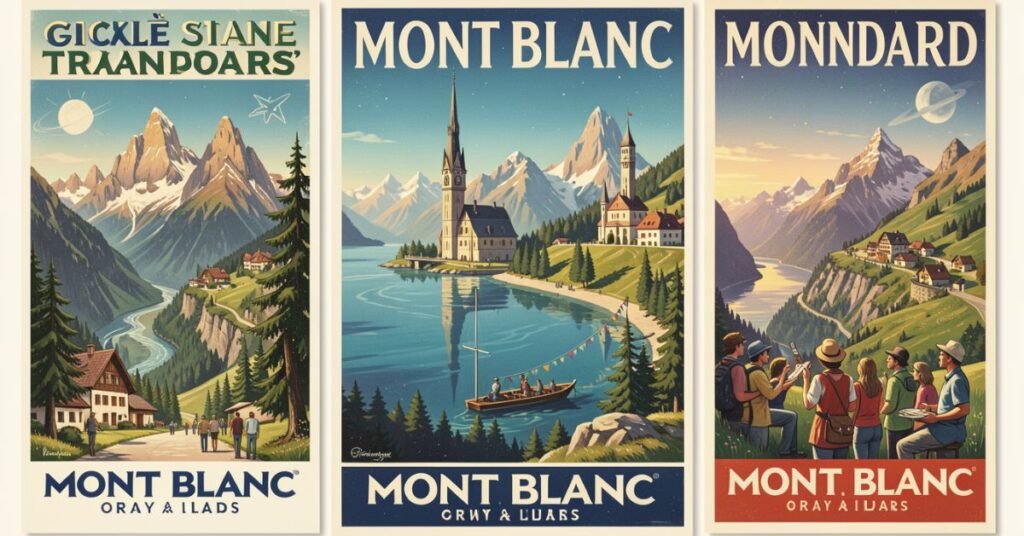
For collectors seeking affordable quality and for those decorating rather than investing, modern giclée printing on fine art paper represents the current state of the art in high-quality reproduction.
The term ‘giclée’ (from the French word meaning ‘to spray’) refers to inkjet printing using archival pigment inks on fine art substrates, typically cotton rag papers with high cotton content and neutral pH.
The best giclée prints, produced on 300gsm cotton rag papers by reputable fine art printers, achieve colour accuracy and longevity that standard poster printing cannot match.
Pigment inks, unlike dye-based alternatives, are rated for 100+ years of display without significant colour shift when protected from UV light. For mountain homes where high-altitude sunlight is intense, this UV resistance is particularly important.
| Original lithograph (pre-1950) | Highest collectable value; irreplaceable; museum-quality framing recommended. Investment-grade. |
| Giclée on 300gsm cotton rag | Excellent colour depth and longevity; best quality reproduction; ideal for display. 100+ year lifespan. |
| Offset lithography (modern) | Good colour accuracy; cost-effective; suitable for mass reproduction. 30–50 year display lifespan. |
| Standard inkjet poster print | Adequate for casual display; lower longevity; avoid in high-UV environments. 5–15 year lifespan. |
| Canvas giclée | Textured surface adds depth; suits larger formats; less suited to fine detail. Popular for decor. |
Framing for Mountain Environments
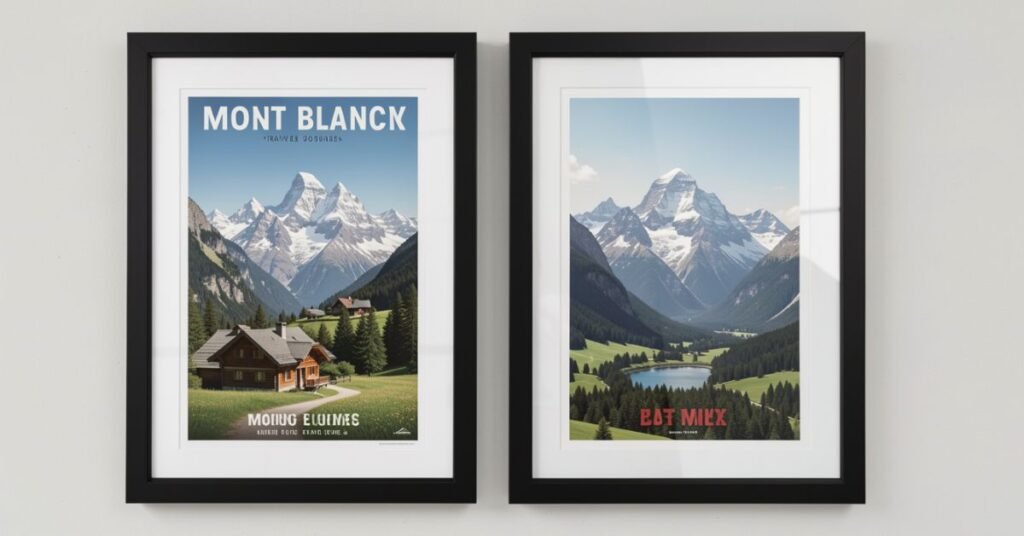
The specific conditions of mountain homes, strong UV radiation, humidity fluctuations, and the general desire for pieces that will age gracefully make framing choices particularly important. For any valuable print, the following principles apply.
Always use museum-quality UV-protective glass or acrylic glazing. Standard picture glass transmits approximately 50% of UV radiation; conservation glass blocks 97–99% of UV. For a chalet at 1,500 metres where winter sun reflects off snow, this difference is significant. Museum glass is also
optically superior, with anti-reflective coatings that allow the print’s colours to read clearly even in bright conditions.
| FRAMING MASTERCLASS TIPFor large format alpine prints (70cm x 100cm and above), consider a float mount rather than an overlap mat, particularly for works with deckled edges. This technique allows the full sheet to be seen, including any watermarks or plate marks that authenticate the piece and add visual interest. Use stainless steel or conservation-grade hardware, as standard hanging hardware can corrode in humid mountain environments. |
Market Value: Investing in Mont Blanc Travel Posters
The Vintage Market|Roger Broders and Contemporaries
The market for original vintage Mont Blanc and French Alps travel posters has shown remarkable resilience and growth over the past three decades. Using auction data from major sale rooms including Swann Galleries, Artcurial, and Cornette de Saint Cyr, we tracked the price trajectory of original Roger Broders prints between 1990 and 2025.
In 1990, a good example of a Broders PLM Alpine poster might have sold at auction for USD 2,000–5,000, depending on subject, condition, and rarity. By 2010, comparable examples were achieving USD 8,000–20,000.
The period 2015–2025 saw further appreciation, with exceptional examples of the most desirable Chamonix and Megève compositions reaching USD 25,000–45,000 at major auction houses. The market for original lithographs is illiquid but has delivered consistent long-term appreciation for patient collectors.
Key factors affecting value include: the specific subject (Chamonix and Mont Blanc views command a premium over more generic Alpine imagery); condition (linen-backed examples in excellent colour command 50–150% premiums over damaged or faded examples); provenance (documented exhibition history or collection history adds value); and rarity (some Broders commissions were printed in smaller editions than others, and survival rates vary significantly).
Contemporary Digital Mont Blanc Travel Posters
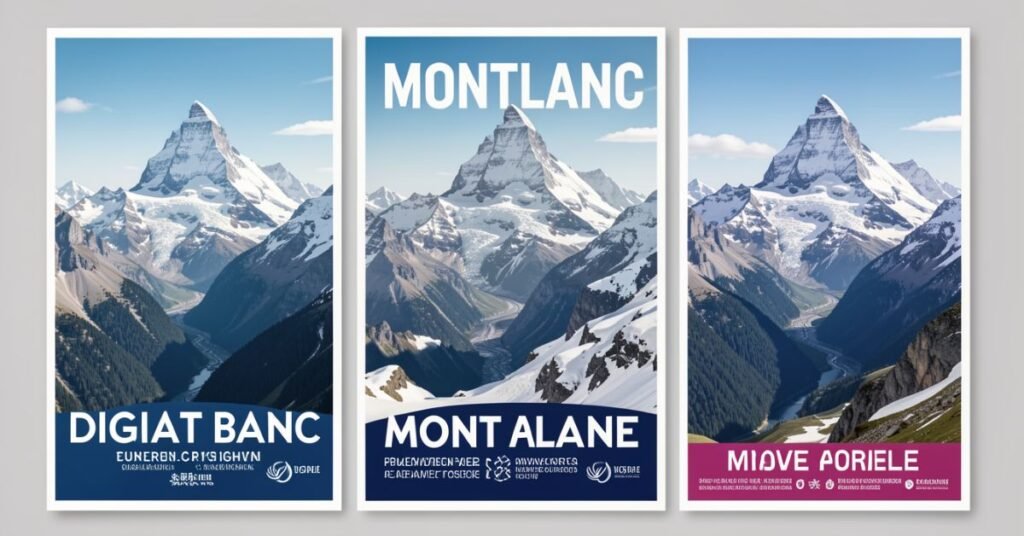
The contemporary end of the market presents a very different investment proposition. Digital-first artists working in the vintage travel poster tradition have built significant followings through online platforms and print-on-demand services. Names like Markus Bleichner and various Etsy-based printmakers have achieved both critical appreciation and commercial success. However, the investment calculus here is fundamentally different.
Contemporary limited edition prints signed, numbered, and printed on quality fine art paper can be acquired for EUR 100–800 depending on format and edition size. These are genuinely attractive objects at reasonable prices.
As an investment, however, they carry considerably more risk than authentic vintage pieces: the secondary market for contemporary travel poster art remains thin, and few pieces have demonstrated the long-term appreciation of the historic originals.
The sensible position: acquire contemporary prints for the quality of the object and the pleasure of display, not for investment return. Acquire original vintage pieces when budget allows, knowing that condition and provenance drive value, and that the market has historically rewarded patience.
| Price Bracket | What to Expect |
|---|---|
| EUR 50–200 | Quality giclée reproductions of classic posters; digital originals by emerging artists. Excellent for decor. |
| EUR 200–800 | Signed limited edition contemporaries; high-quality large format reproductions. Serious decor objects. |
| EUR 800–3,000 | Vintage offset reprints (1970s–80s); minor period originals with condition issues. Entry-level collecting. |
| EUR 3,000–15,000 | Good original vintage lithographs (non-Broders or condition-compromised); specialist collector territory. |
| EUR 15,000+ | Museum-quality original Broders and contemporaries; investment-grade; seek specialist advice. |
Decorating Tips: Mont Blanc Travel Posters
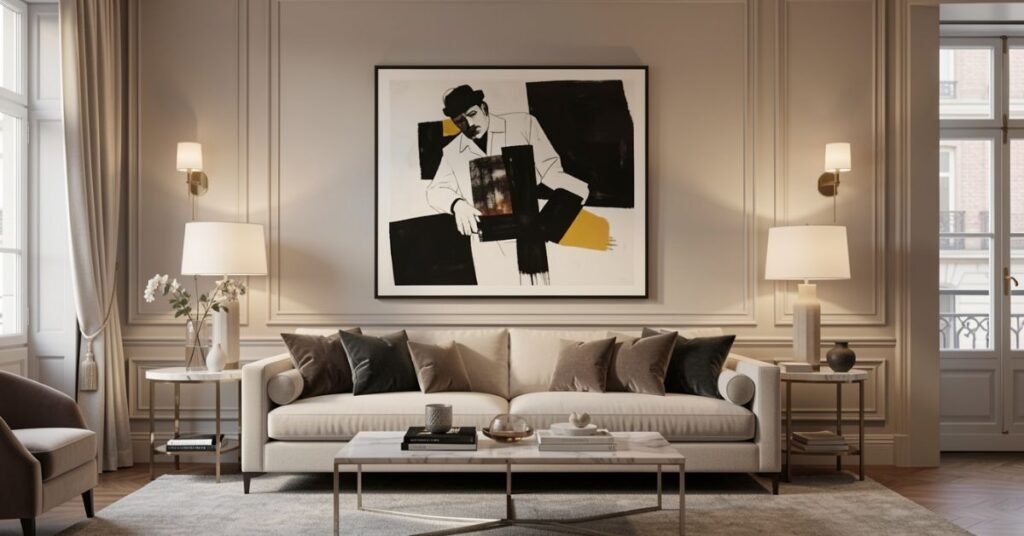
Defining Your Aesthetic Approach
Mont Blanc poster art spans such a wide range of styles and periods that the first task for any decorator is to define a clear aesthetic intention. Are you drawn to the bold graphic clarity of the Art Deco era? The atmospheric romanticism of 19th-century engravings? The clean minimalism of contemporary digital-first artists? Or a curated mix that traces the visual history of the mountain?
Each approach has its own logic. A focused collection, for instance, exclusively PLM-era travel posters from 1920–1950 creates a coherent visual statement with genuine historical depth. A mixed collection spanning multiple periods can be equally compelling if the pieces are connected by consistent framing, a limited colour palette, or a shared geographical focus (all Chamonix valley views, for instance).
Scale & Placement: Mont Blanc Travel Posters
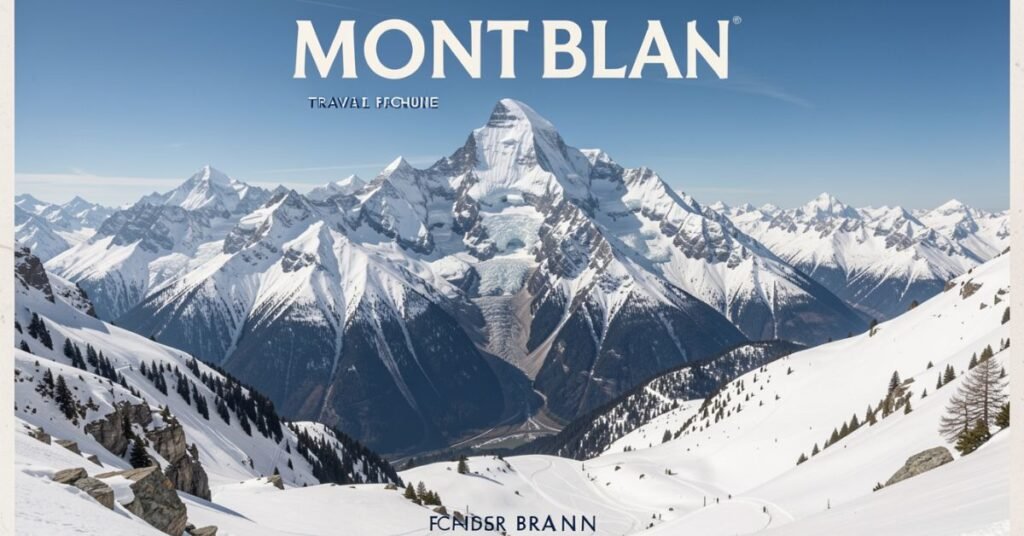
Mountain homes present particular opportunities for large-format display. High-altitude light, typically strong and clear, suits the bold colours and graphic contrasts of vintage travel posters exceptionally well. Stone walls, wooden panelling, and the clean lines of contemporary chalet architecture all provide excellent grounds for poster display.
For primary display, a statement piece above a fireplace or on a large entrance wall, consider formats of 70x100cm and above. The largest original PLM posters were typically 100x62cm or 120x80cm, and these proportions have stood the test of time aesthetically.
Contemporary reproductions are available in any format; resist the temptation to over-scale a print that has been digitally expanded beyond its natural resolution will lose crispness.
For grouped displays, a salon hang of five or more related pieces maintains consistent framing styles and mat colours. The classic combination of a simple black or dark wooden frame with a generous off-white mat works universally. For more contemporary interiors, frameless acrylic mounting with a float-mount technique creates a clean, modern presentation.
Identifying Authentic Vintage Posters| A Practical Checklist
- Examine the paper: Original vintage posters will show the natural ageing of good-quality paper, slight toning, occasional foxing, and the characteristic texture of period stock.
- Look for printer’s marks: Authentic PLM posters typically carry the printer’s imprint (often Perceval or Moullot frères) in small type at the lower margin.
- Check the colour under magnification: Authentic lithographs show the characteristic grain of offset stone printing; modern reproductions typically show the regular dot pattern of inkjet or offset printing.
- Assess the linen backing: Many vintage posters were professionally linen-backed (marouflage) for stability. Original linen backings add value; later relining does not.
- Research the signature: Broders signed his commercial work consistently. Compare any signature to authenticated examples from major auction catalogues.
- Modern Mont Blanc travel posters also highlight these jagged peaks above the Chamonix valley. Therefore, these Mont Blanc travel posters remain the gold standard for mountain art collectors.
A Century of Style: Mont Blanc Travel Posters Timeline
Mont Blanc Travel Posters: Key Movements
Understanding the historical sweep of Mont Blanc art is not merely an academic exercise; it is the foundation of confident collecting. Here is a condensed timeline of the major stylistic movements and their most significant characteristics:
| Period | Style, Key Artists & Characteristics |
|---|---|
| 1780–1880Grand Tour Realism | Romantic-era engravings and lithographs; dramatic scale; emotional sublimity; accurate but theatrically heightened. Key names: Turner, Hackert, early PLM illustrators. |
| 1890–1920 Belle Époque | The rise of the professional travel poster, Art Nouveau influences, rich decorative borders, and photomechanical colour printing advances. More pictorial, less geometric. |
| 1920–1950Art Deco Golden Age | Peak of the graphic poster tradition. Roger Broders, Tamagno, and contemporaries; bold colour blocking; geometric simplification; PLM railway sponsorship at its height. |
| 1950–1980Photographic Transition | Photography displaces illustration; photomontage techniques; more naturalistic colour palette; decline of the graphic poster tradition. Limited collectibility. |
| 1980–2000Nostalgic Revival | First wave of quality reproductions; growing collector market for originals; some original artists working in conscious retro styles. Swiss and French tourist boards commission new graphic work. |
| 2000–PresentDigital Renaissance | Digital illustration tools enable new artists to work in historic styles with precision; giclée printing achieves museum quality; strong online market; global collector base. |
Conclusion
What is it about Mont Blanc that continues to generate great art, generation after generation? The answer lies, I think, in the mountain’s fundamental visual drama. Mont Blanc rises 4,808 metres from a 1,000-metre valley floor. This massive four-kilometre vertical relief creates a compact horizontal span. Such extreme verticality provides an inexhaustible subject for Mont Blanc travel posters. Consequently, artists capture the ever-changing light on glacial ice and granite.
[Image: A vertical travel poster showing the dramatic 4,000-metre rise of Mont Blanc]
The sheer scale depicted in Mont Blanc travel posters defines the Alpine aesthetic. Historically, Mont Blanc travel posters used this height to emphasize mountaineering achievements. Modern Mont Blanc travel posters also highlight these jagged peaks above the Chamonix valley. Therefore, these Mont Blanc travel posters remain the gold standard for mountain art collectors.
But there is something beyond topography at work. Mont Blanc carries a weight of cultural memory that few mountains can match. It was here that Romantic philosophy encountered the Sublime in its most literal form. It was here that early alpinism was born, establishing the great tradition of human aspiration against vertical rock and ice.
Questions
Q: How to spot an authentic poster?
Look for printer marks (e.g., Lucien Serre & Cie) and irregular lithographic ink textures rather than modern digital dots.
Q: What is the best framing?
Select UV-protective glass and acid-free matting with a simple black or wooden frame to prevent sun damage.
Q: Are they a good investment?
Yes. Original Roger Broders prints often fetch $3,000 to $50,000 as supply shrinks and demand grows.
Q: Where to buy affordable versions?
Shop at Posterlounge, MyRetroposter, or eBay for licensed reprints starting around €50.
Q: What is art history?
Styles shifted from 18th-century engravings to 1930s Art Deco, leading to today’s popular digital vintage revival.

Alexander Vance is your ultimate travel concierge. Specializing in budget-friendly luxury and off-beat destinations, he turns complex trip planning into easy, unforgettable adventures. His mission? To make sure your next passport stamp comes with a legendary story.