
The most common Italian travel phrases cover five everyday situations: greetings (Ciao, Buongiorno), politeness (Grazie, Per favore, Scusi), restaurants (Il conto, per favore), directions (Dov’è…?), and emergencies (Aiuto, Ho bisogno di un medico). Learning around 30–40 essential phrases is enough to handle most everyday interactions while traveling in Italy.
You don’t need to become fluent before your trip.Most travelers just want to order food, ask for directions, or say thank you without worrying about making mistakes. The good news is that Italians usually appreciate even a small effort to speak their language. In this guide, you’ll learn the most useful Italian phrases for real travel situations, along with easy pronunciation tips and when to use formal or casual expressions, so you can explore Italy with more confidence.
Essential Italian Phrases Can Make Your Trip Easier
Italy ranks among the world’s most visited countries, yet English fluency outside major tourist hubs like Rome, Florence, and Venice remains inconsistent. Industry experts in travel and hospitality often note that smaller towns, family-run trattorias, and regional train stations are where a traveler’s Italian vocabulary gets tested most.
A common mistake is assuming that tone of voice or hand gestures can substitute for vocabulary. They can’t, particularly in transactional moments like paying a bill, asking for a pharmacy, or clarifying a train platform. Learning even 30 to 40 reliable phrases reduces miscommunication, speeds up everyday transactions, and signals respect for local culture, which Italians generally appreciate and reciprocate with friendlier service.
Also Read : The Ultimate Italian Food Menu: A Traveler Guide to Authentic Flavors
Formal vs. Informal Italian: A Distinction Travelers Often Miss
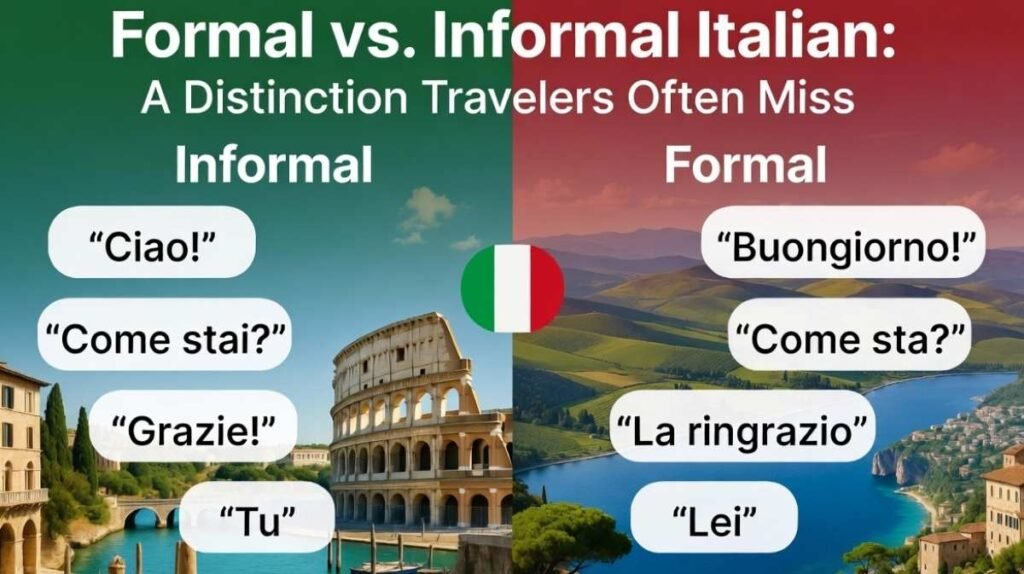
Italian has two ways of addressing people: the informal tu and the formal Lei. Most English phrasebooks skip this entirely, yet it affects which version of a phrase sounds natural in a given setting.
- Use Lei (formal) with shopkeepers, waiters, hotel staff, police, and anyone older or unfamiliar.
- Use tu (informal) with peers, children, and people you’ve become friendly with.
- When unsure, default to formal. Italians rarely take offense at excess formality, but casual speech toward a stranger can come across as abrupt.
Most phrases in this guide use the formal register, since that covers the majority of traveler interactions: hotels, restaurants, shops, and transport staff.
Basic Italian Greetings and Everyday Phrases
These are the highest-frequency common Italian phrases for travel — the ones you’ll use within minutes of landing and dozens of times a day after that.
| English | Italian | Pronunciation |
| Hello / Hi | Ciao | chow |
| Good morning | Buongiorno | bwon-JOR-no |
| Good evening | Buonasera | bwoh-nah-SEH-rah |
| Goodnight | Buonanotte | bwoh-nah-NOT-teh |
| Goodbye (formal) | Arrivederci | ah-ree-veh-DEHR-chee |
| Please | Per favore | pehr fah-VOH-reh |
| Thank you | Grazie | GRAH-tsee-eh |
| You’re welcome | Prego | PREH-go |
| Excuse me | Mi scusi | mee SKOO-zee |
| I’m sorry | Mi dispiace | mee dees-PYAH-cheh |
| Yes / No | Sì / No | see / no |
| Do you speak English? | Parla inglese? | PAR-lah een-GLEH-zeh |
| I don’t understand | Non capisco | non kah-PEES-koh |
Note: Italian pronunciation is largely phonetic vowels are consistent, and double consonants (like the “zz” in pizza) are held slightly longer than in English. This makes Italian one of the more approachable European languages for new speakers to pronounce correctly on the first attempt.
Italian Phrases for Restaurants and Dining
Italy’s dining culture has its own etiquette, and the phrases below reflect that — including the often-overlooked phrase for requesting the bill, since servers rarely bring it unprompted.
| English | Italian | Pronunciation |
| A table for two, please | Un tavolo per due, per favore | oon TAH-voh-loh pehr DOO-eh |
| I would like… | Vorrei… | vor-RAY |
| The menu, please | Il menù, per favore | eel meh-NOO |
| What do you recommend? | Cosa consiglia? | KOH-zah kon-SEEL-yah |
| The bill, please | Il conto, per favore | eel KON-toh |
| Is the tip included? | Il servizio è incluso? | eel sehr-VEE-tsyoh eh een-KLOO-zoh |
| I’m allergic to… | Sono allergico/a a… | SOH-noh al-LEHR-jee-koh ah |
| Water, please | Acqua, per favore | AHK-wah pehr fah-VOH-reh |
| Enjoy your meal | Buon appetito | bwon ah-peh-TEE-toh |
A common mistake first-time visitors make is asking for a doggy bag or expecting separate checks by default. Based on current standards in most Italian restaurants, the bill is brought as one total unless split is requested in advance, and tipping is modest compared to the U.S., often just rounding up or leaving small change.
Asking for Directions and Getting Around in Italian
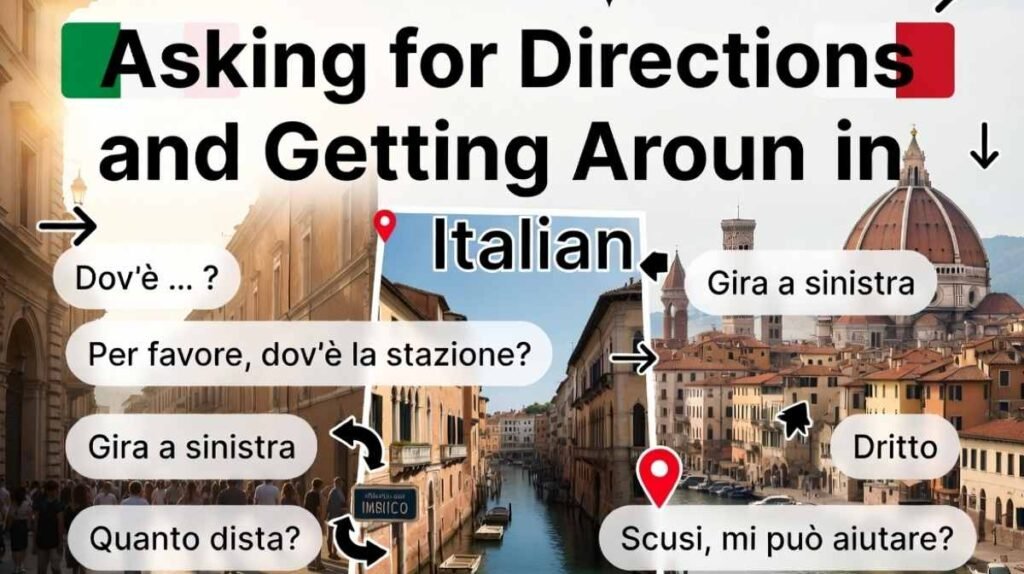
Finding your way around is much easier when you know a few basic Italian phrases. Here are some of the most useful ones to remember while traveling.
Whether you’re navigating a train station, catching a taxi, or exploring a new city, these Italian phrases will help you get around with confidence.
- Where is…? — Dov’è…? (doh-VEH)
- How do I get to…? — Come arrivo a…? (KOH-meh ar-REE-voh ah)
- Is it far? — È lontano? (eh lon-TAH-no)
- One ticket, please. — Un biglietto, per favore. (oon beel-YET-toh)
- Which platform? — Quale binario? (KWAH-leh bee-NAH-ryoh)
- Left / Right / Straight ahead — Sinistra / Destra / Dritto (see-NEES-trah / DEH-strah / DREET-toh)
- Where is the bathroom? — Dov’è il bagno? (doh-VEH eel BAHN-yoh)
Italian Phrases for Shopping and Markets
| English | Italian | Pronunciation |
| How much does it cost? | Quanto costa? | KWAN-toh KOS-tah |
| Can I try this on? | Posso provarlo? | POS-soh proh-VAR-loh |
| Do you have a smaller/larger size? | Ha una taglia più piccola/grande? | ah OO-nah TAHL-yah pyoo PEEK-koh-lah |
| Do you accept credit cards? | Accettate carte di credito? | ah-chet-TAH-teh KAR-teh dee KREH-dee-toh |
| It’s too expensive | È troppo caro | eh TROP-poh KAH-roh |
| I’ll take it | Lo prendo | loh PREN-doh |
Emergency Italian Phrases Every Traveler Should Know
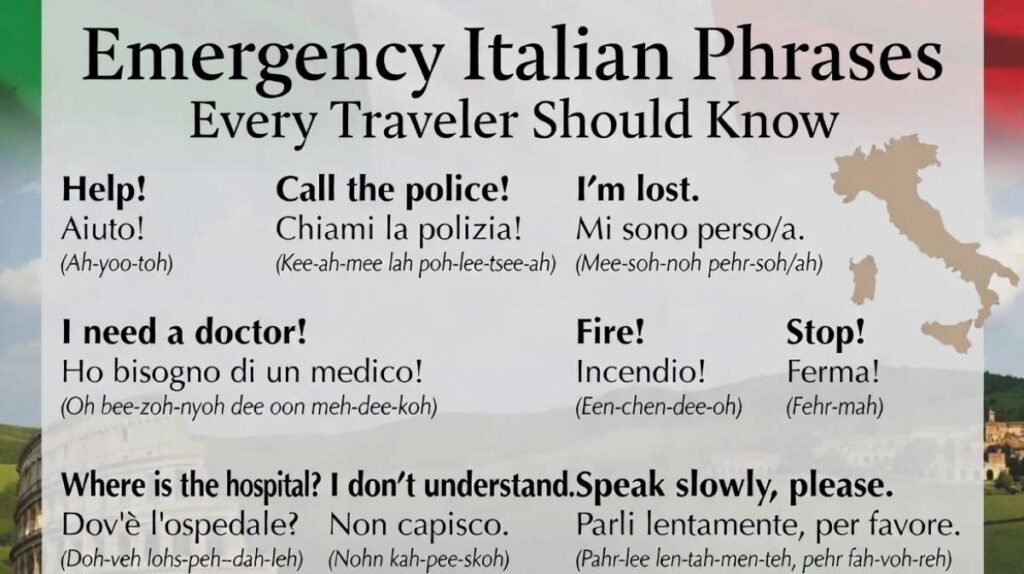
Most phrasebooks for Italy emphasize dining and shopping but underprepare travelers for emergencies. These phrases matter more than any other category on this list, even though they’re used far less often.
- Help! — Aiuto! (ah-YOO-toh)
- I need a doctor — Ho bisogno di un medico (oh bee-ZOHN-yoh dee oon MEH-dee-koh)
- Call the police — Chiami la polizia (KYAH-mee lah poh-lee-TSEE-ah)
- It’s an emergency — È un’emergenza (eh oon eh-mehr-JEN-tsah)
- I’ve lost my passport — Ho perso il passaporto (oh PEHR-soh eel pas-sah-POHR-toh)
- Where is the nearest hospital? — Dov’è l’ospedale più vicino? (doh-VEH lohs-peh-DAH-leh pyoo vee-CHEE-noh)
The general emergency number in Italy is 112, which connects to police, ambulance, and fire services and operates nationwide, including in English in many regions.
Common Italian Phrases for Travel: Quick-Reference Comparison by Situation
| Situation | Most Useful Phrase | Pronunciation | Frequency |
| Greeting anyone | Buongiorno | bwon-JOR-no | Very High |
| Restaurant | Il conto, per favore | eel KON-toh | High |
| Directions | Dov’è…? | doh-VEH | High |
| Shopping | Quanto costa? | KWAN-toh KOS-tah | Medium |
| Transport | Un biglietto, per favore | oon beel-YET-toh | Medium |
| Emergency | Ho bisogno di un medico | oh bee-ZOHN-yoh dee oon MEH-dee-koh | Low but critical |
How to Say Numbers in Italian for Travel
| Number | Italian | Pronunciation | More |
| 1 | Uno | OO-noh | 6 — Sei (SEH-ee) |
| 2 | Due | DOO-eh | 7 — Sette (SET-teh) |
| 3 | Tre | treh | 8 — Otto (OT-toh) |
| 4 | Quattro | KWAT-troh | 9 — Nove (NOH-veh) |
| 5 | Cinque | CHEEN-kweh | 10 — Dieci (dee-EH-chee) |
For larger numbers: 20 is Venti (VEN-tee), 50 is Cinquanta (cheen-KWAN-tah), and 100 is Cento (CHEN-toh).
Telling Time and Days of the Week in Italian
- What time is it? — Che ore sono? (keh OH-reh SOH-noh)
- Today / Tomorrow / Yesterday — Oggi / Domani / Ieri
- Monday–Sunday: Lunedì, Martedì, Mercoledì, Giovedì, Venerdì, Sabato, Domenica
In practice, many museums and shops in Italy close on a specific weekday, often Monday, so recognizing the day name on a posted sign can save a wasted trip.
Useful Words for Transport and Getting Around Italy
| English | Italian | Pronunciation |
| Train station | Stazione | stah-TSYOH-neh |
| Bus stop | Fermata dell’autobus | fer-MAH-tah del-OW-toh-boos |
| Taxi | Taxi | TAHK-see |
| Airport | Aeroporto | ah-eh-roh-POR-toh |
| Exit | Uscita | oo-SHEE-tah |
| Entrance | Entrata | en-TRAH-tah |
| Is this seat taken? | È occupato questo posto? | eh ok-koo-PAH-toh KWES-toh POS-toh |
Words to Know When Visiting Museums in Italy
- Ticket office — Biglietteria (beel-yet-teh-REE-ah)
- Is there a student/senior discount? — C’è uno sconto per studenti/anziani?
- Is photography allowed? — È permesso fotografare?
- What time does it close? — A che ora chiude?
- Guided tour — Visita guidata
Common Italian Sayings That Show Cultural Fluency
Learning a few common Italian sayings can help you understand everyday conversations and connect more naturally with locals. While you may not use them every day, you’ll often hear these expressions during your trip and in casual conversations.
- In bocca al lupo — Italian for “break a leg”
- Acqua in bocca — “keep it a secret”
- Non vedo l’ora — “I can’t wait”
- Salvare capra e cavoli — resolving a tricky situation without losing anything
- Non c’è problema — “no problem”
How to Practice Italian Travel Phrases Before Your Trip
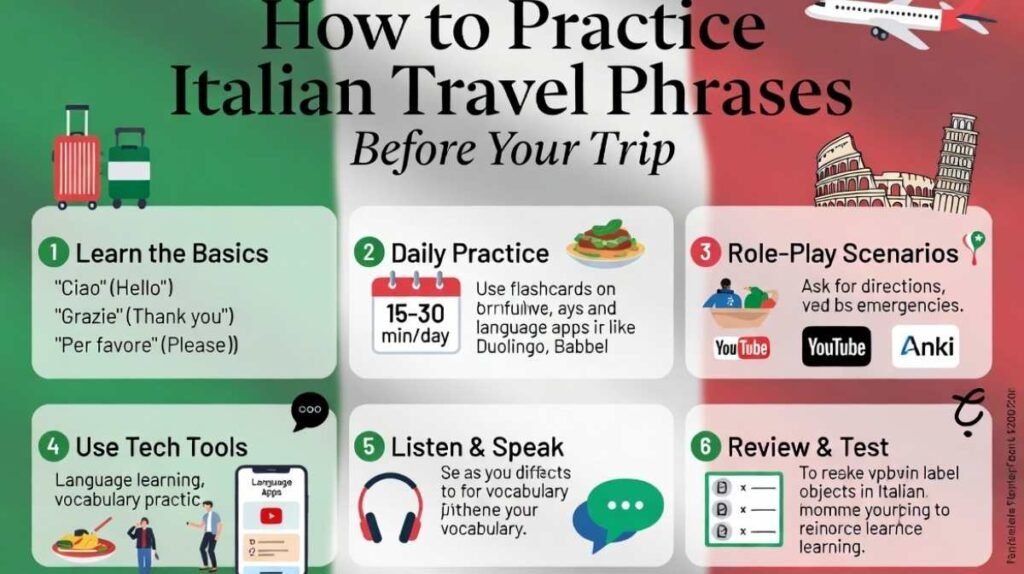
You don’t need to memorize hundreds of words before visiting Italy. Focusing on a small group of useful phrases and practicing them regularly will help you communicate more naturally and confidently during your trip. A little preparation goes a long way.
- Group phrases by situation, not alphabetically or by grammar rule.
- Practice out loud, not just by reading.
- Use a phrase 3–5 times in low-stakes settings before relying on it under pressure.
- Carry a printable or offline version for areas with inconsistent data access.
A common mistake is trying to memorize 100+ phrases before departure. In practice, fluency in 30 to 40 well-chosen phrases, used confidently, outperforms shaky recall of a much longer list.
FAQ
What are most common Italian phrases for travel?
Ciao, Grazie, Per favore, Dov’è…?, and Il conto, per favore cover the majority of everyday interactions.
Do I need to learn Italian before visiting Italy?
No, but 30–40 basic phrases significantly improve the experience, especially outside major tourist hubs.
How do you say thank you in Italian?
Grazie (GRAH-tsee-eh); Grazie mille for added emphasis.

Alexander Vance is your ultimate travel concierge. Specializing in budget-friendly luxury and off-beat destinations, he turns complex trip planning into easy, unforgettable adventures. His mission? To make sure your next passport stamp comes with a legendary story.