
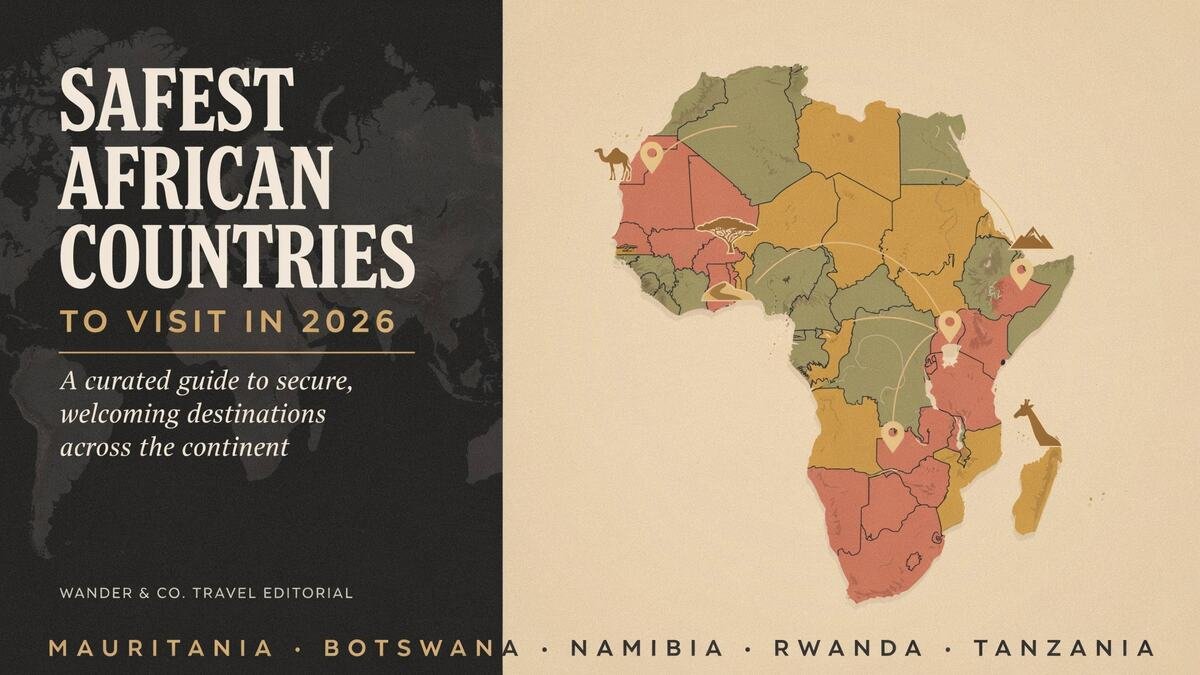
Most people think of Africa as one place. It is not. It is 54 countries, millions of square miles, and completely different safety levels depending on where you go. Some parts are as calm and welcoming as any European destination. Others are genuinely dangerous and best avoided. This guide cuts through the noise and gives you the real picture.
We ranked these countries using the Global Peace Index (GPI), official government travel advisories, and on-the-ground traveler feedback. The lower the GPI score, the more peaceful the country.
What Does “Safe” Actually Mean in Africa?
Safety is not just about crime rates. When we say a country is safe to visit, we mean it scores well across five areas: political stability, crime against tourists, healthcare access, road safety, and disease risk.
A country can have low crime but terrible road infrastructure. Another might have occasional petty theft but world-class hospitals and tourist protection. We weigh all of it together.
Top 7 Safest African Countries to Visit in 2026
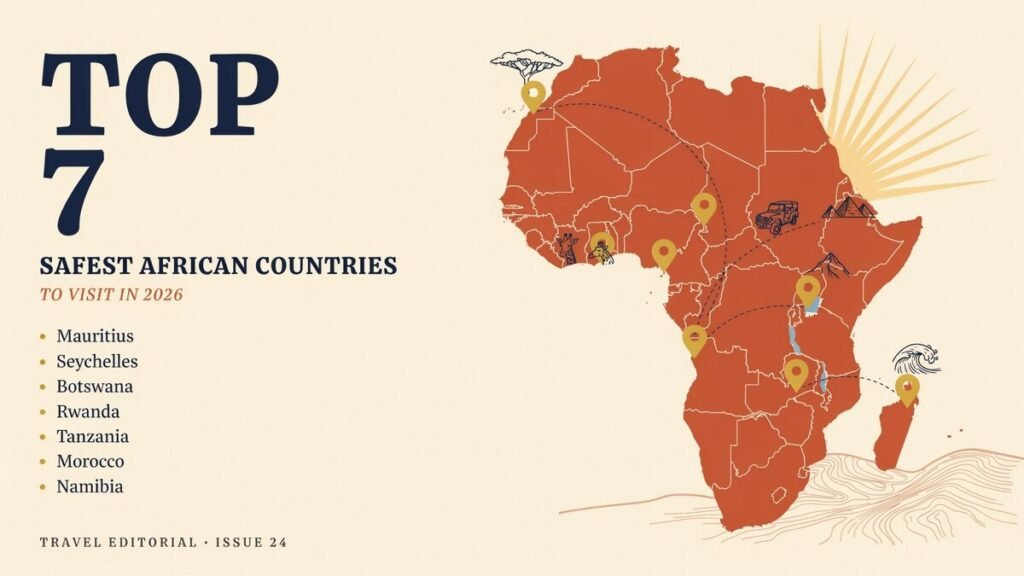
1 Mauritius
Mauritius sits at the top of the list for a reason. It has a GPI score of 1.586, making it the most peaceful country on the entire continent. Crime against tourists is extremely rare, and the government has built a well-managed tourism infrastructure over decades.
You get Indian Ocean beaches, luxury resorts, whale watching, scuba diving, and the famous Le Morne Brabant, a UNESCO World Heritage Site with a stunning lagoon and an optical illusion of an underwater waterfall. It is genuinely one of those places that surprises people who were not expecting to love it this much.
2 Botswana
Botswana ranks second with a GPI score of 1.743, which puts it ahead of Greece and Italy on the global peace rankings. It has one of Africa’s longest-running stable democracies and extremely low levels of violent crime.
It is also the gold standard for wildlife tourism. The Okavango Delta, Chobe National Park, and the Central Kalahari are world-class safari destinations. The government deliberately keeps tourist numbers low and prices high, which means less crowds and better experiences.
3 Namibia
Namibia scores 1.789 on the GPI and has enjoyed decades of political stability. Its very low population density means crime stays low almost everywhere. Because most of the country is desert, malaria risk is also significantly lower than other African nations.
The red dunes of Sossusvlei, the wildlife waterholes of Etosha National Park, and the coastal town of Walvis Bay are all genuinely breathtaking. Even if you travel solo here, you will feel remarkably at ease.
4. Rwanda
Rwanda’s transformation since the 1990s is one of the most remarkable stories in modern Africa. Today Kigali is considered one of the cleanest and most organized capital cities on the continent. GPI score sits at 2.036 and continues to improve.
The government takes security seriously. Tourist areas are well-monitored. Gorilla trekking in Volcanoes National Park is a bucket-list experience that draws visitors from around the world, and the infrastructure around it is solid and reliable.
5 Seychelles
Seychelles has a GPI score of around 1.70 and is one of only two African countries to consistently rank in the global top 30 for peacefulness. It is a small island nation with a tourism-driven economy, which means keeping visitors safe is a core national priority.
The beaches are among the most photographed in the world. Anse Lazio, Anse Source d’Argent, and Beau Vallon are all easily accessible and genuinely beautiful. It is on the expensive side, but the safety and scenery justify it for most travelers.
6. Morocco
Morocco is North Africa’s most stable and tourist-friendly country, with a GPI rating of 2.012. Over 12 million tourists visit every year and the government maintains heavy security in all major tourist areas and cities.
Marrakesh, Fes, Chefchaouen, and the Sahara Desert route are all well-worn tourist trails with solid safety records. The only thing to keep in mind is that Morocco has conservative dress standards, especially outside major cities. Light clothing that covers shoulders and knees is both respectful and practical in the heat.
7. Zambia
Zambia scores 1.9164 on the GPI and is one of the most underrated safari destinations in Africa. It is quieter than Kenya or South Africa, which means smaller crowds in national parks and more genuine interactions with guides who actually know the land.
Victoria Falls is partly shared with Zimbabwe, and the Zambian side tends to be less touristy and more accessible. South Luangwa National Park is excellent for leopard sightings. The Lower Zambezi offers canoe safaris that most visitors do not even know exist.
Real Traveler Experience

When James Okafor, a Lagos-based travel writer, first planned a solo trip across Southern Africa, he spent two full weeks researching safety before booking anything. His biggest fear was not wildlife. It was not crime. It was booking the wrong country based on outdated information he found on sites that had not updated their content since 2021.
He ended up using the Global Peace Index as his starting point, cross-referencing it with live government travel advisories. His verdict after three weeks across Botswana, Zambia, and Malawi? He felt safer in all three than he expected, and said the biggest danger he encountered was underestimating how much he would want to extend his trip.
According to the Global Peace Index published by Vision of Humanity, countries like Botswana and Mauritius consistently outrank many European nations for overall peacefulness. You can check the latest rankings here:
Source: visionofhumanity.org
Travel Tips for Beginners
Carry travel insurance. Medical emergencies in remote areas can be expensive and complicated without it. Basic policies start around $25 for a five-day trip.
Get your vaccinations sorted at least four weeks before departure. Yellow fever is mandatory for several East African countries. Typhoid, hepatitis A, and malaria prophylactics are widely recommended depending on your destination.
Do not drive yourself unless you are very experienced with African roads. Road fatality rates are high across much of the continent. Join a tour or hire a local guide instead.
Check your government’s travel advisory for your specific destination within Africa, not just Africa as a whole. The US State Department, UK Foreign Office, and Canadian government all publish regularly updated country-by-country guidance.
For staying connected throughout your trip, a travel eSIM is one of the most practical tools you can have. It keeps navigation, emergency contacts, and news accessible without the hassle of swapping physical SIM cards at every border.
Read Also this Artcle: Best Travel apps
FAQ
Q: Which is the number one safest country in Africa to visit?
Mauritius consistently ranks first with a Global Peace Index score of 1.586, making it safer than many European countries including the UK and Italy.
Q: Is Africa safe for solo female travelers?
Several African countries are considered very safe for solo female travelers, particularly Mauritius, Botswana, Rwanda, and Namibia. Standard precautions apply, and it is always worth researching local cultural norms before arrival.
Q: Which African countries should I avoid in 2026?
Sudan, South Sudan, the Democratic Republic of Congo, Mali, Burkina Faso, and Somalia all carry the highest risk ratings in 2026 and are not recommended for tourist travel.

Alexander Vance is your ultimate travel concierge. Specializing in budget-friendly luxury and off-beat destinations, he turns complex trip planning into easy, unforgettable adventures. His mission? To make sure your next passport stamp comes with a legendary story.